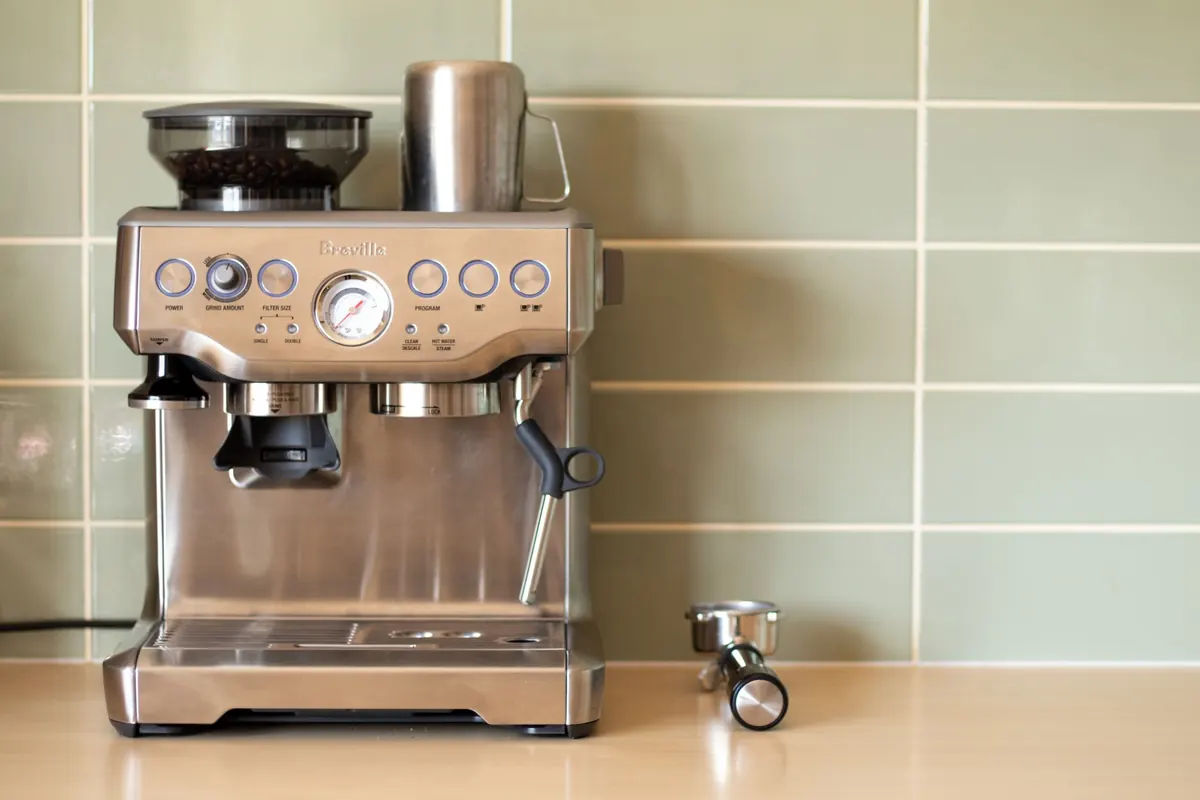
Nine bar. It's on the gauge, in the manual, in every forum thread about a shot that runs too fast. And yet most people pulling espresso at home have never really felt what nine bar does — they've only watched the needle sit there while the coffee came out sour, or bitter, or in four seconds flat, and wondered which number to blame. Pressure isn't a setting you choose once and forget. It's a force that meets the coffee, and what happens at that meeting decides most of what lands in your cup.
Nine bar is nine times atmospheric pressure, roughly 130 pounds per square inch. That's comfortably more than the air in a car tyre. The number only matters because of where it's applied: the top of a packed disc of coffee, maybe 18 to 20 grams of it, sitting in a basket a few centimetres wide and barely a centimetre deep. Water is being forced through a bed of particles with almost no space between them, and every drop that reaches your cup has been squeezed through that bed on the way.
The first thing worth holding onto: pressure is potential, not action. Nine bar sitting behind a puck does nothing until the coffee resists it. Two shots can be pulled at exactly the same pressure and taste completely different, because the coffee in the basket decided how the water moved.
It's a convention, not a law of physics. The lever machines that defined espresso in the middle of the last century delivered pressure that started high and fell away as the spring relaxed — generally somewhere around eight or nine bar at the start of the shot. When electric pump machines took over, nine bar was the sensible target, because it reproduced what baristas already knew how to work with.
There's slack around the number. Some light-roast coffees, ground fine, behave beautifully at six or seven bar over a longer, gentler shot. Traditional blends often want a firm nine or ten. Machines with pressure profiling treat nine bar as a waypoint rather than a destination. If you're starting out, nine is a good place to stand while you learn what everything else does.
This is the part that trips people up. Your pump doesn't decide how fast the shot runs. Given a fixed pressure, flow is set almost entirely by how much the puck resists — which in practice means grind, dose, and how evenly the coffee was distributed.
Grind finer and the same nine bar pushes water through more slowly. Grind coarser and the shot races. Nothing about the pump changed. You moved the resistance.
The puck isn't static. In the first seconds the coffee swells as it wets, fines migrate downward and settle into gaps, and the bed compresses. Sometimes it cracks at the edge where the basket meets the wall, and water finds that crack in preference to the coffee. That's channeling: the pressure is still nine bar, but most of the water is travelling through a channel instead of the puck, so the coffee it does touch gets hammered while the rest barely gets wet.
Pressure is the energy behind extraction. Push harder and you drive more out of the grounds per second — but you also push water through faster, which shortens contact time. Those two effects pull against each other, and balancing them is most of what dialling in means.
Notice that none of these say "the pressure was wrong." On a machine with a fixed pump, pressure is the constant and the coffee is the variable. You adjust the coffee.
Two machines can both claim nine bar and behave nothing alike.
Many gauges read the pressure at the pump or in the boiler, not at the group. By the time water has travelled through the pipework, the group head and the shower screen, the pressure at the top of the puck is lower — how much lower depends on the machine. Treat a gauge as a trend indicator, not a laboratory reading.
A vibration pump sold as a "15 bar" pump is quoting the maximum it can produce against a closed valve. In a working espresso machine, an over-pressure valve bleeds off the excess so the group sees something closer to nine. Set that valve high and you'll get firmer shots and more channeling; set it too low and the shot tastes flat and thin.
Many machines wet the puck at one to three bar before full pressure arrives. That gentle phase lets the coffee swell evenly, which makes cracks less likely later in the shot. If your machine has it, it's usually working in your favour.
Treat nine bar as a solid default and put your attention where it earns a return: fresh coffee, a consistent dose, a grind that gives you a reasonable flow, and a level puck before the water arrives. Get those right and nine bar will taste the way it's supposed to.
If your shots run fast and sour, grind finer before you suspect the pump. If they choke and drip, go coarser. If they look fine but taste hollow, check your ratio and your beans before you go hunting for a pressure problem that probably isn't there.
And if you're tempted to open the machine and adjust the over-pressure valve: unplug it first, remember that some valves are sealed and not meant to be moved, and be honest about whether the shot in your cup is really worse than the one you'd get by buying better coffee. Most of the time, the beans are the shorter path.
Photo: Nathan Baldwin / Pexels